The best time to buy plot India is driven by four overlapping cycles: the macro real estate cycle of 7-10 years, the annual budget cycle that creates infrastructure-driven price spikes, the seasonal cycle where monsoon and year-end quarters offer better negotiation leverage, and the micro-market cycle specific to each corridor's infrastructure timeline. For premium plots above Rs 3 crore, the January-March quarter consistently offers the strongest negotiation window as sellers prioritize closing before the financial year ends and developers seek to meet annual targets. The period immediately before Union Budget announcements, typically late January, represents the best pre-catalyst entry point. Waiting for price corrections in supply-constrained premium corridors has historically cost buyers 12-18% per year in missed appreciation. The optimal strategy is not timing the bottom but entering before the next identifiable catalyst.
Key Takeaways
- The January-March quarter offers the best negotiation window as sellers rush to close before financial year-end.
- Buying before Union Budget infrastructure announcements captures the pre-catalyst price before 8-12% spikes.
- Monsoon months see 15-25% lower transaction volumes, creating pockets of seller flexibility on resale plots.
- Indian real estate runs on 7-10 year macro cycles, and the current upcycle shows no signs of peaking.
- Waiting for corrections in premium corridors above Rs 3 crore has cost buyers 12-18% annually since 2021.
The Gurugram Investor's December Playbook
That Sector 95 purchase followed a deliberate pattern. December in Indian real estate is a dead zone for most buyers: NRIs have returned abroad after Diwali visits, domestic buyers are consumed with tax-saving investments and year-end financial planning, and site visits drop as winter fog settles over North India. Transaction volumes in Gurugram typically fall 20-30% between November and January. See our guide on corner plot ROI vs apartments.
But for a buyer with capital ready, this is precisely when leverage shifts. Individual sellers who missed the festive window become more negotiable. Developers sitting on unsold inventory from October launches offer quiet discounts that never appear in marketing materials. The gap between listed price and closed price widens to 5-8%, compared to 1-3% during the frenzied September-October season. See our guide on premium plot pricing trends.
◆ Part of our Investment & Legal Guide
The investor paid Rs 38,000 per sq ft against a listed rate of Rs 41,000. That Rs 3,000 per sq ft discount on 2,400 sq ft saved him Rs 72 lakh at purchase, which compounded further when the corridor appreciated 21% over the next ten months.
The Best Time to Buy Plot India: Four Cycles That Matter
The Macro Cycle (7-10 Years)
Indian real estate operates on recognizable multi-year cycles. The last major downturn ran from 2014 to 2017, driven by the RERA implementation shock, demonetization, and GST introduction. The recovery phase lasted from 2018 to 2020, followed by the current expansion phase that began in 2021 and has accelerated through 2025.
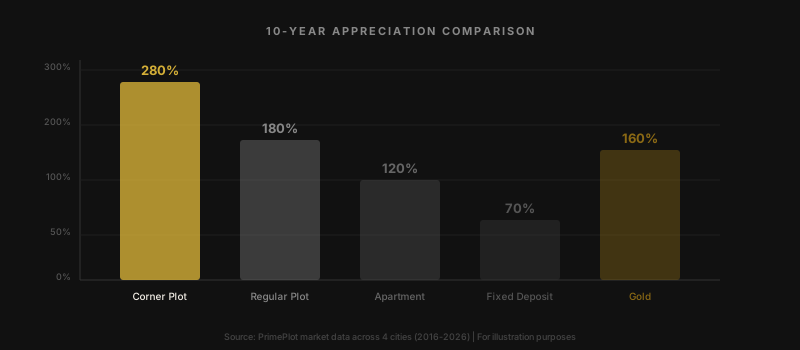
Within this macro cycle, the premium plot segment has outperformed every sub-cycle. Even during the 2014-2017 downturn, premium plots in established corridors like Bangalore's Devanahalli or Hyderabad's Jubilee Hills held value while apartments in the same cities dropped 10-15%. Land does not overbuild, and premium locations do not lose their structural appeal.
The Budget Cycle (Annual)
The Union Budget, typically presented in early February, is the single most impactful event for Indian real estate pricing. Infrastructure allocations create immediate price responses in affected corridors. The 2025 Budget's Rs 11.11 lakh crore capital expenditure allocation, with significant portions directed at urban transport and road infrastructure, pushed plot prices in metro-adjacent corridors up 5-8% within weeks of announcement.
The optimal strategy: identify corridors likely to receive Budget allocation (based on pre-Budget committee reports and state submissions) and purchase in December-January. Post-Budget, the same plots become 8-12% more expensive within 30-45 days.
The Seasonal Cycle
The widespread belief that Diwali and Navratri are the best times to buy property is a cultural preference, not a financial one. Data from registration offices across all four metros shows that festive season buyers pay 3-5% more than January-March buyers for equivalent properties, because sentiment-driven demand inflates prices precisely when everyone is buying.
The seasonal breakdown by negotiation leverage:
- January-March (Best): Financial year-end pressure on sellers and developers. Maximum flexibility on pricing.
- April-June (Good): New financial year, fresh inventory launches, early-bird pricing from developers.
- July-September (Mixed): Monsoon slowdown reduces traffic but also limits site visits. Good for resale negotiation.
- October-December (Expensive): Festive rush inflates prices. NRI demand peaks. Lowest negotiation leverage.
Infrastructure Catalysts: The Most Predictable Timing Signal
The single most reliable timing signal for plot purchases is the infrastructure development timeline. Every major infrastructure project follows a predictable sequence: announcement, land acquisition, tender award, construction commencement, and completion. Plot prices respond at each stage, with the steepest appreciation occurring between announcement and construction commencement.
Current catalysts to watch for 2025-2026:
- Bangalore STRR: Satellite Town Ring Road tenders awarded, construction beginning mid-2025. Plots within 3 km of interchange points are in the steepest appreciation phase.
- Hyderabad RRR: Regional Ring Road land acquisition nearing completion. Entry window narrowing as construction visibility increases.
- Lucknow Metro Phase II: Detailed project report approved, tendering underway. Strongest pre-construction entry opportunity among all four cities.
- Gurugram-Manesar Metro: DPR approved, alignment finalized. Sectors along the proposed route are already pricing in 10-15% premium.
The Cost of Waiting: A Rs 3 Crore Lesson
Consider a buyer who identified a premium corner plot in North Bangalore at Rs 3 crore in January 2023 but decided to wait for a correction. That same plot category now costs Rs 4.2-4.5 crore in mid-2025, representing Rs 1.2-1.5 crore in missed opportunity. Even if a 5% correction materialized (which it has not), the buyer would still be paying significantly more than the 2023 price.
For premium plots in infrastructure-adjacent corridors, the data since 2021 is unambiguous: every quarter you wait costs more than any timing discount you might capture. The optimal approach is to buy when you have conviction on the corridor and the capital to close, then let the infrastructure timeline do the compounding work.
Written on a foggy December morning in Sector 63, Gurugram, where the Southern Peripheral Road stretches southward and the only other person on the plot was a surveyor measuring boundaries with a yellow tape.