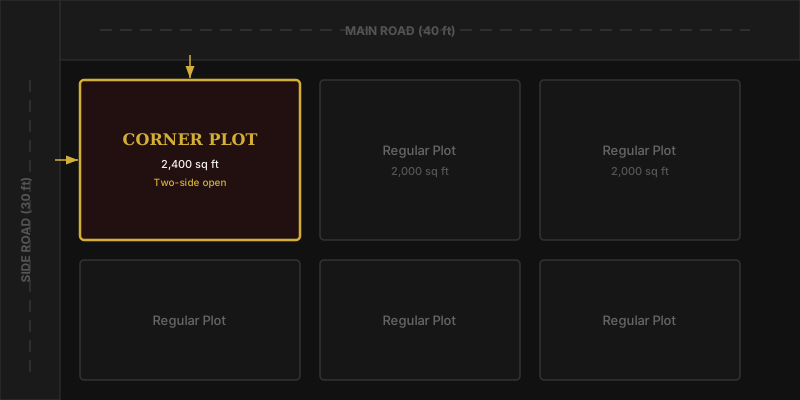
The minimum plot size for a luxury home in India is 1,800 sq ft, and this number is driven by regulation, not preference. After mandatory setbacks — which range from 1.5 to 3 metres on each side depending on city and plot size — a 1,800 sq ft plot yields approximately 1,050 to 1,150 sq ft of buildable ground floor area. This is the smallest footprint that can accommodate a genuine luxury layout: a 14-by-16-foot master bedroom, a living-dining space that does not feel like a corridor, a kitchen large enough for a full staff setup, parking for at least two luxury vehicles with adequate turning radius, and a garden strip wide enough for a child to play in. Below 1,800 sq ft, setbacks compress the buildable area so severely that the home begins to feel like a premium apartment placed on the ground — spacious interiors become impossible regardless of how much you spend on finishes. For corner plots, the threshold is even higher at 2,000-2,400 sq ft because of dual setback requirements on both road-facing sides.
Key Takeaways
- Setbacks consume 35-45% of a plot's area, making 1,800 sq ft the minimum for luxury proportions.
- A 1,200 sq ft plot yields only 650-720 sq ft buildable footprint — inadequate for luxury room sizes.
- Two luxury vehicles need a minimum 6.5-metre-wide driveway, requiring at least 1,800 sq ft of plot.
- Corner plots need 2,000-2,400 sq ft minimum due to setbacks on two road-facing sides.
- Garden space starts at 200 sq ft for a functional outdoor area — impossible below 1,800 sq ft plots.
Why Arjun Chose the Larger Plot — A Walkthrough
Arjun had originally budgeted for the 1,200 sq ft plot. At 11,000 per sq ft in Sector 72, it cost 1.32 crore. The 2,100 sq ft plot in Sector 76, at 9,500 per sq ft, cost 2.0 crore. A 68,000 rupee difference in investment that felt steep — until he walked through the implications with his architect. See our guide on corner plot resale value data.
On the 1,200 sq ft plot, DTCP-mandated setbacks of 3 metres on the front (road-facing) side, 2 metres on the rear, and 1.5 metres on each lateral side consumed 480 sq ft. The buildable footprint was 720 sq ft. Across two floors, the total built-up area would be 1,440 sq ft — tight for a four-bedroom home. The driveway, squeezed into the 3-metre front setback, could park one car parallel to the boundary wall. His Mercedes GLE would fit; his wife's Audi Q5 would have to park on the street or in a cramped stilt parking space with pillars that risked door dings.
◆ Part of our Corner Plots Guide
On the 2,100 sq ft plot, the same setback rules consumed 560 sq ft. The buildable footprint was 1,540 sq ft — more than double the usable ground coverage. The driveway expanded to 7 metres wide, accommodating both cars side by side with a metre to spare. A 280 sq ft garden wrapped around the building on two sides, visible from the living room and master bedroom.
The Setback Arithmetic Every Buyer Must Understand
Indian building regulations require mandatory open space between your building and the plot boundary on all sides. These setbacks serve fire safety, ventilation, and urban density control purposes. They are non-negotiable — you cannot build into them, and any construction that violates setbacks is liable for demolition.
The setback rules vary by city and by plot size:
- Bangalore (BBMP): For plots up to 2,400 sq ft — 1.5m rear, 1.5m sides, 3m front on 40-foot roads. For plots above 2,400 sq ft — 3m on all sides.
- Hyderabad (HMDA): Minimum 1.5m on all sides for plots up to 200 sq metres. For larger plots, 2-3m setbacks apply depending on building height.
- Lucknow (LDA): 3m front setback, 1.5m sides and rear for residential plots up to 2,000 sq ft. Larger plots require 3m on all sides.
- Gurugram (DTCP): 3m front, 2m rear, 1.5m sides for residential licensed colonies. Some sectors have stricter norms requiring 3m on all sides.
On a typical 30-by-60 foot (1,800 sq ft) plot in Bangalore with 1.5-metre side setbacks and 3-metre front setback, the calculation yields a buildable footprint of approximately 1,080 sq ft. On a 30-by-40 foot (1,200 sq ft) plot, the same setbacks leave only about 700 sq ft. That 380 sq ft difference on the ground floor — multiplied across two floors — is the difference between luxury and compromise.
Parking: The Space That Defines Your Daily Experience
Premium buyers in the three crore and above segment typically own at least two cars, often three. The vehicles are not compact hatchbacks — they are full-size sedans (BMW 5 Series, Mercedes E-Class) and large SUVs (Range Rover, Toyota Land Cruiser, Audi Q7). Each of these vehicles requires a parking bay of approximately 3 by 5.5 metres, plus a driving lane of at least 3.5 metres for manoeuvring.
Many architects claim that stilt parking solves the space problem on smaller plots — but stilt parking with load-bearing pillars every 4 metres creates a garage-like entry experience that contradicts the open, welcoming arrival that luxury homeowners expect.
On a 1,800 sq ft plot, the front setback area (3 metres deep, 9 metres wide on a standard 30-foot frontage) provides roughly 27 sq metres — enough for two parallel parking bays with a 3.5-metre driving lane. A covered carport structure can be added without enclosing the sides, maintaining the open feel while protecting vehicles from Bangalore's afternoon rain or Gurugram's summer sun.
On a 1,200 sq ft plot, the same front setback gives only about 18 sq metres. One car fits comfortably. The second car can be squeezed in only by eliminating the driving lane, which means backing out directly onto the road — a daily inconvenience that erodes the living experience.
Garden and Outdoor Space: Where Luxury Breathes
A luxury home without outdoor space is an expensive apartment with extra stairs. The garden, however modest, is what separates independent living from flat living in the minds of premium buyers. Children play there. Families have their evening tea there. Festival decorations are set up there. Without it, the independent home loses its emotional centre.
On an 1,800 sq ft plot, after building footprint and driveway, you can create a garden of 200-300 sq ft — small but functional. Enough for a lawn strip, a few mature plants, and a seating area for four. On a 2,400 sq ft plot, the garden expands to 400-600 sq ft, accommodating a genuine outdoor dining setup or a small water feature.
On a 1,200 sq ft plot, the garden is essentially eliminated. After building footprint, setbacks, and parking, the remaining open space is the setback itself — a narrow strip between your building and the boundary wall that functions as a drainage channel and utility corridor, not a garden.
Room Proportions: What Fits Inside 1,800 Sq Ft
A luxury master bedroom needs a minimum of 200 sq ft (approximately 14 by 14 feet) to accommodate a king-size bed, bedside tables, a sitting area, and a walk-in wardrobe entrance. The attached bathroom needs another 80-100 sq ft for a separate shower enclosure, bathtub, and twin vanity.
On a 1,800 sq ft plot with 1,080 sq ft ground-floor footprint, a ground-plus-one design yields about 2,100 sq ft of total built-up area. After deducting staircases (80 sq ft per floor), walls (approximately 15% of built-up area), and utility spaces, the usable area is roughly 1,550 sq ft. This accommodates:
- One master bedroom at 200 sq ft with 90 sq ft bathroom
- Two additional bedrooms at 150 sq ft each with 60 sq ft bathrooms
- A living-dining area of 300 sq ft
- A kitchen of 120 sq ft with a separate utility area
- A guest powder room and entrance foyer
This is the minimum configuration that feels genuinely luxurious. Drop below 1,800 sq ft of plot, and the bedrooms shrink to 120-130 sq ft (hotel-room proportions), the living room narrows to a passage-like 220 sq ft, and the kitchen loses its utility separation — features that premium buyers specifically move from apartments to avoid.
In Arjun's Sector 76 garden, his daughters play badminton on summer evenings while the scent of curry leaves from the kitchen drifts through the open plan — the small luxury that no apartment, however expensive, ever delivered.