Correct vastu for plot boundary wall and gate placement requires differential wall heights — 5-6 feet on the south and west sides, 3-4 feet on the north and east — and precise gate positioning using the pada (grid segment) system. The main gate on a north wall should sit in the fourth pada counting from the northeast corner, while an east wall gate should be in the fourth or fifth pada from the same corner. These placements channel energy entry through the most auspicious zones. For corner plots with dual road exposure, the primary gate should face the more favourable direction (north or east), with the secondary gate on the other road. Getting these details right during initial construction costs nothing extra but correcting them later means demolishing and rebuilding sections of your compound wall, which typically runs Rs 30,000-60,000 in material and labour waste across Indian metro markets.
Key Takeaways
- South and west boundary walls should be 5-6 feet tall; north and east walls should be 3-4 feet.
- The main gate belongs in the fourth pada of the north or east wall, counted from the northeast corner.
- Corner plots should have the primary gate on the north or east wall and a secondary on the other road.
- Gate placement corrections after wall construction cost Rs 30,000-60,000 in wasted material and labour.
- Engaging a Vastu consultant before compound wall construction saves money and ensures correct energy flow.
What Deepa's Rs 45,000 Mistake Taught Her About Timing
Deepa had done everything right with her plot purchase. The 2,200 sq ft northeast corner plot in Hennur scored 88% on her consultant's Vastu assessment. The direction was ideal, the shape was rectangular (40x55 feet), the slope was correct, and the soil was laterite with excellent bearing capacity. She had paid Rs 4.1 Crore for it, confident in its long-term value.
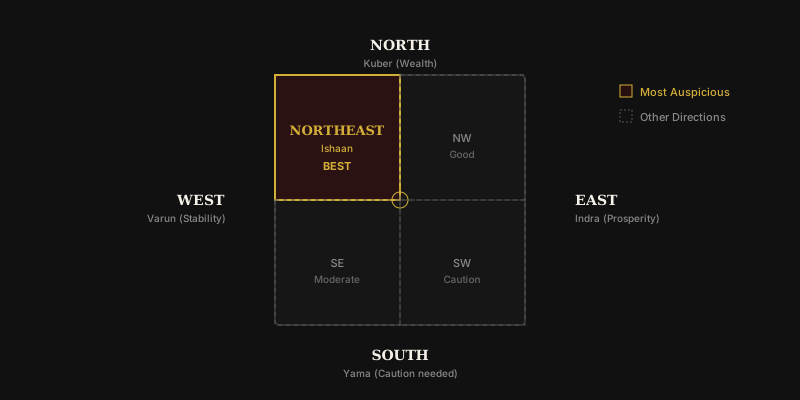
Her mistake was starting compound wall construction before finalizing the Vastu layout. The contractor she hired was experienced and efficient but unfamiliar with Vastu-specific wall height differentials. He built all four walls at a uniform 5 feet — standard construction practice but exactly wrong for the north and east sides. And he placed the gate where the site plan showed the driveway, which happened to be in the seventh pada of the north wall — a zone that Vastu associates with unfavourable energy entry.
◆ Part of our Vastu & Compliance Guide
The correction took three days, cost Rs 45,000, and delayed the project by a week. For a Rs 4.1 Crore investment, it was a minor setback. But it was entirely preventable if the Vastu consultant had been involved before the mason started work, not after.
Vastu Boundary Wall Height Rules for Corner Plots
The boundary wall is the first physical structure on your plot, and in Vastu terms, it defines the energy container. Just as a vessel's shape determines how liquid flows inside it, your compound wall's height profile determines how directional energies circulate within your property.
South and West Walls: The Heavy Sides
Build these at 5-6 feet with solid brick or stone construction. No jali work, lattice panels, or open grille sections. These walls represent the earth and fire elements and should create a strong, grounding barrier. In Hyderabad's Mokila and Gandipet developments, where premium plots back onto rocky terrain, many owners extend the south wall to 7 feet using natural stone that matches the landscape.
North and East Walls: The Light Sides
Keep these at 3-4 feet. You can add decorative grille or lattice work above the solid base to reach the minimum height required by your layout's building bylaws while maintaining Vastu openness. Some layout associations mandate uniform 5-foot compound walls across all plots, which directly contradicts Vastu differential height principles. In these cases, buyers can maintain the lower visible wall height by landscaping the inner perimeter of the north and east walls with low shrubs that do not add visual mass.
Gate Placement Using the Vastu Pada System
Each boundary wall is conceptually divided into nine equal segments called padas. Each pada carries a specific energy associated with a Vedic deity. For gate placement, only certain padas allow favourable energy entry:
- North wall: Fourth pada from the northeast corner (Mukhya zone) is ideal. Fifth pada is acceptable.
- East wall: Fourth and fifth padas from the northeast corner are both auspicious.
- South wall: Fourth pada from the southeast corner is the only acceptable position if a south gate is unavoidable.
- West wall: Fourth pada from the northwest corner works for secondary vehicular access.
For a 40-foot north wall, each pada is approximately 4.4 feet wide. The fourth pada begins at 13.2 feet from the northeast corner and ends at 17.6 feet. Your gate opening should fall within this range. A standard pedestrian gate of 3.5-4 feet width fits comfortably within one pada. A vehicular gate of 8-10 feet spans two padas, which is acceptable as long as the centre of the gate aligns with the fourth pada.
Corner Plot Gate Strategy: Two Gates, One Hierarchy
Corner plots offer the unique advantage of dual road access, but Vastu requires a clear hierarchy between the two gates. The primary gate — where family members, guests, and deliveries enter — should face the more auspicious direction. The secondary gate serves vehicular access or service entry.
For a northeast corner plot with roads on the north and east:
- Primary gate: North wall, fourth pada — this is the main entrance for daily use
- Secondary gate: East wall, fourth pada — used for car access or service entry
For a southwest corner plot with roads on the south and west:
- Primary gate: Place on the south wall in the fourth pada from the southeast corner
- Secondary gate: West wall, fourth pada from the northwest corner for vehicular access
- Enhancement: Create a covered portico or entrance pavilion at the primary gate to buffer the direct southern energy
In Gurugram's premium sectors, many architects design elaborate entrance courtyards that act as Vastu transition zones between the road and the home. This approach works particularly well for south and west-facing gates where a buffer space between the gate and the main door reduces direct energy exposure.
Material and Design Considerations
The compound wall's construction material and finish affect both its Vastu function and its aesthetic contribution to your property's street presence.
Brick with plastered finish is the most common choice across all four cities. It provides solid mass for the south and west walls and can be finished to match the home's exterior palette. Cost: Rs 800-1,200 per running foot at 5-foot height.
Natural stone adds visual weight and is particularly effective for south and west walls in hilly terrain. In Hyderabad, Tandur stone is popular. In Bangalore, Sadarahalli granite provides a distinctive dark finish. Cost: Rs 1,500-2,500 per running foot.
Exposed brick or laterite is gaining popularity in premium developments for its organic appearance. It works well for all four walls when combined with height differentiation. Cost: Rs 1,000-1,800 per running foot.
Avoid hollow blocks for the south and west walls — their hollow cores reduce the mass that Vastu prescribes for these heavier sides. Hollow blocks are acceptable for the north and east walls above the solid base, where lighter construction is actually preferred.
On Hennur Road, the corrected compound wall now stands at its proper differential heights, and the gate opens in its rightful pada — a quiet alignment that Deepa feels each morning as the first light enters through the lower north wall exactly as it should.