The corner plot road facing advantages in India extend far beyond simple aesthetics. A two-road-facing corner plot provides dual vehicle access that eliminates driveway conflicts for multi-car families, cross-ventilation from two open sides that reduces cooling costs by 15-25%, and a structural scarcity premium — only 12-18% of plots in any layout are corners — that drives 25-40% higher resale values compared to interior positions. The dual frontage allows architects to separate the formal entrance from service and utility access, creating cleaner home designs. For premium buyers investing above three crore rupees, the two-road advantage also unlocks Vastu flexibility, allowing entrance placement on the more auspicious road direction. Property tax is marginally higher (5-8% annually), but this cost is offset many times over by the faster appreciation rate that corner positions consistently deliver across Bangalore, Hyderabad, Lucknow, and Gurugram markets.
Key Takeaways
- Dual road frontage enables flow-through driveways eliminating reversing for luxury vehicle owners.
- Two-road-facing plots command 25-40% premiums and appreciate 20-45% faster than interior plots.
- Cross-ventilation from two open sides cuts annual air conditioning costs by one lakh rupees or more.
- Separate formal and service entrances create cleaner architectural designs and better Vastu compliance.
- Only 12-18% of plots in any layout are corners, ensuring permanent structural scarcity.
How the Deshmukhs Designed Around Dual Access
When the Deshmukhs bought their 2,800 sq ft corner plot in a premium Kokapet layout in 2022, they paid 1.85 crore — 32% more than the identical-size interior plot two positions away, which sold for 1.40 crore. Their architect, working with the two-road advantage, designed something impossible on a single-road plot.
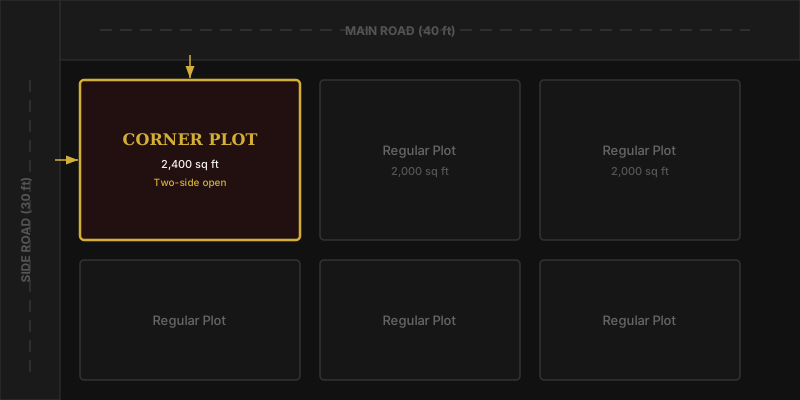
The south-facing road (the wider of the two at 40 feet) received the formal entrance — a grand double-height portico with a paved circular driveway large enough for four cars and a turning radius suited to a full-size sedan. The east-facing road (30 feet) received the service entrance — a separate gate for household staff, deliveries, gardening equipment, and a utility parking bay for service vehicles.
◆ Part of our Corner Plots Guide
Inside the home, this separation translated to a clean floor plan. Guests approaching from the south entrance walked into a formal foyer leading to the living room and dining area. Staff entering from the east side moved directly to the kitchen and utility zones without crossing the family's private areas. The architect described it as designing two homes in one — a public-facing house and a private service house, joined seamlessly.
The Ventilation and Light Dividend of Two Open Sides
An interior plot in a typical Indian layout has neighbours on three sides. The only open face is the road-facing front. Heat builds up on the enclosed sides, especially during afternoon hours when the western wall absorbs maximum solar radiation. Mechanical cooling becomes necessary for six to eight months of the year in cities like Bangalore and Hyderabad.
A two-road-facing corner plot breaks this thermal trap. Air moves freely from one road face through the house and out the other, creating genuine cross-ventilation. In Bangalore's climate, this means bedrooms positioned along the corner axis can remain comfortable without air conditioning from October through February and during most monsoon evenings from June through September.
The light advantage is equally practical. A corner home can have windows on two external walls in every room along the junction, pulling natural light deep into the floor plan. Architects designing premium homes on corner plots in Hyderabad's Narsingi layouts report that only bathrooms and interior utility rooms require artificial lighting during daytime — every other space gets sufficient natural illumination.
A home that breathes on two sides ages differently. The reduced moisture trapping means fewer damp walls, less paint deterioration, and lower maintenance costs over the building's lifetime.
Why the Premium Pays for Itself: Resale Data
The 25-40% premium paid at purchase for a two-road-facing corner plot is not a sunk cost — it is an investment that compounds. Transaction data from four PrimePlot cities tells a consistent story.
In Bangalore's Sarjapur Road layouts, corner plots purchased in 2020 at an average of 4,500 per sq ft resold in 2024-2025 at 7,200-8,100 per sq ft — a 60-80% gain. Interior plots in the same layouts purchased at 3,500 per sq ft resold at 4,900-5,400 — a 40-54% gain. The corner premium was 29% at purchase and delivered 20-26 percentage points of additional return.
Some analysts argue that the corner premium represents a bubble driven by Vastu-motivated demand rather than functional value — but the consistent outperformance across Hindu, Muslim, and Christian-majority buyer segments suggests the premium is rooted in utility, not belief.
In Gurugram's Sector 72-80 licensed colonies, corner plots have shown even stronger relative performance. The Dwarka Expressway opening in 2024 lifted all property values, but corner positions captured a disproportionate share of the appreciation because the improved road connectivity amplified their dual-access advantage.
Architectural Possibilities Unique to Two-Road Corners
Architects working with two-road-facing plots can deploy design strategies that are structurally impossible on interior sites. The most impactful is the L-shaped floor plan, where the building wraps around the corner with two wings extending along each road. This creates a private courtyard garden at the inner angle — sheltered from both road sides, naturally ventilated, and visible from every major room.
Another exclusive design is the staggered entry approach. Instead of a single front door, the home presents two distinct facades — a formal elevation on the primary road and a more casual, garden-oriented elevation on the secondary road. Families use the secondary entrance for daily life while the formal entrance remains a statement piece for guests and occasions.
For buyers with home offices or professional consulting practices, the two-road design allows a genuinely independent office entrance on the secondary road, with a separate waiting area and meeting room that clients can access without entering the family home. This is increasingly valuable for doctors, lawyers, chartered accountants, and consultants in cities like Lucknow and Hyderabad where home-based practices are common in the premium segment.
What to Consider Before Buying a Two-Road Corner
The dual road frontage introduces specific planning requirements that buyers must address before construction. Setback compliance on both sides is mandatory — in Bangalore, BBMP requires minimum 3-metre setbacks on all road-facing sides for plots above 2,400 sq ft, reducing your buildable footprint compared to an interior plot with only one road-facing setback.
Noise management is a legitimate consideration, though often overstated. In gated communities with 30-40 foot internal roads and 20 km/h speed limits, traffic noise at corner positions is minimal. In open layouts on public roads, the noise differential is more noticeable. A well-designed compound wall with dense hedge planting reduces road noise by 8-12 decibels — bringing a 60-decibel corner down to a 48-52 decibel range, comparable to a quiet interior plot.
Security planning for two road-facing sides requires camera coverage of both frontages, potentially two automated gates, and perimeter lighting along a longer boundary wall. The additional security infrastructure costs approximately 2-3 lakh rupees more than a single-frontage setup. Modern smart home systems can manage both gates, all cameras, and perimeter sensors from a single app, making the operational complexity minimal despite the larger coverage area.
On Kokapet's corner evenings, the west wind slips in off one road while the south breeze rises from the other — two invisible rivers meeting at the exact spot where you chose to build.