The core vastu slope and elevation rules for plots require the southwest corner to be the highest point and the northeast corner the lowest, with a gentle gradient of 1-3 degrees between them. This southwest-to-northeast slope serves both Vastu energy principles and practical drainage engineering — rainwater flows away from the structurally heavy southwest zones toward the northeast, where collection or municipal drainage is most efficient. Before purchasing any premium plot above Rs 3 Crore, commission a topographic survey (Rs 8,000-15,000) to map elevation at all four corners and the centre. Plots with correct natural slope save Rs 2-8 lakh in grading costs during construction. Plots with reversed slope can be corrected during construction but add cost, complexity, and time. Plots with extreme counter-slope (more than 24 inches reversed) should be avoided entirely in the premium residential segment.
Key Takeaways
- The southwest corner must be the highest elevation and the northeast the lowest for proper Vastu compliance.
- A gentle 1-3 degree gradient from southwest to northeast is ideal for energy flow and rainwater drainage.
- Topographic surveys costing Rs 8,000-15,000 reveal slope data invisible to the naked eye on flat terrain.
- Minor slope corrections during construction cost Rs 2-5 lakh; major corrections run Rs 5-12 lakh or more.
- Plots with natural correct slope save significant construction costs and deliver better long-term drainage performance.
What Suresh's Waterlogged Foundation Taught Him About Slope
Suresh had bought the Varthur plot for Rs 3.8 Crore, attracted by its northeast corner position and rectangular shape. On paper, it checked every Vastu box. But he had skipped the topographic survey — an Rs 12,000 expense that seemed unnecessary for what looked like flat terrain. The developer's brochure described all plots in the layout as "level and ready to build."
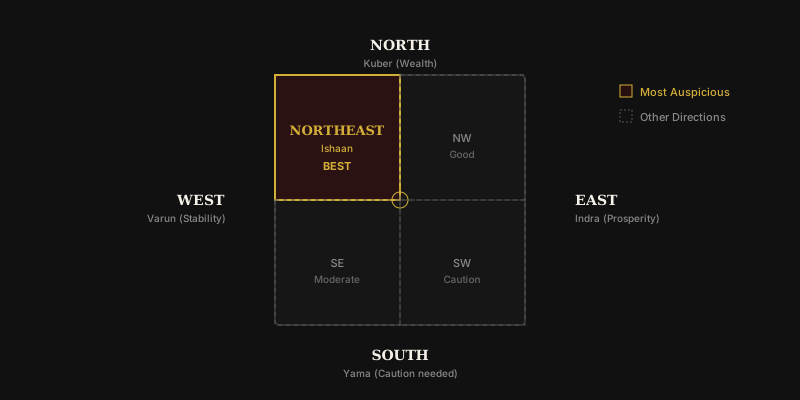
What Suresh could not see with his eyes was a 14-inch elevation difference across the diagonal of his 40x60 feet plot. The northeast corner sat 14 inches higher than the southwest — the exact opposite of what Vastu prescribes. During Bangalore's increasingly intense monsoon, water ran from the northeast to the southwest, pooling against his foundation and seeping into the plinth.
◆ Part of our Vastu & Compliance Guide
Correcting the slope after construction had begun cost Rs 8.5 lakh in earthwork, retaining walls, and re-engineered drainage. A topographic survey before purchase would have revealed the problem, allowing Suresh to either negotiate the price down, demand developer correction, or walk away. Instead, he absorbed the cost along with three months of delay.
Understanding Vastu Slope and Elevation Rules
Vastu Shastra's slope prescription is one of its most practically grounded principles. The ideal elevation hierarchy for any plot, from highest to lowest, follows this sequence:
- Southwest corner — highest point (earth element, stability)
- South and west edges — second highest
- Centre (Brahmasthan) — moderate elevation
- North and east edges — lower than centre
- Northeast corner — lowest point (water element, flow)
This hierarchy means water naturally drains from the heavy, grounded southwest toward the light, flowing northeast. Critics dismiss this as superstition, but the prescription aligns precisely with sound civil engineering practice for the Indian subcontinent, where monsoon drainage is a primary structural concern. The coincidence — or perhaps the insight — is too precise to ignore.
How Slope Varies Across Premium Plot Markets
Bangalore
Bangalore's terrain undulates significantly. The city sits on a plateau at 900 metres above sea level, but within any given square kilometre, elevation can vary by 10-30 feet. Layouts in Whitefield and Sarjapur Road tend to follow natural contours, meaning individual plot slopes vary widely. In Devanahalli, newer layouts on flatter terrain offer more consistent elevation, but developers sometimes fill low-lying areas with construction debris rather than quality soil, creating false elevation that settles over time.
Hyderabad
The granite bedrock around Hyderabad's outer ring road areas — Kokapet, Narsingi, Gandipet — creates naturally stable elevation with predictable slopes. However, the rocky terrain means slope correction requires blasting or heavy machinery, making it significantly more expensive than in alluvial soil regions. A topographic survey is especially critical here because rocky outcrops can create localised high points that distort the overall slope pattern.
Lucknow and Gurugram
Both cities sit on the Indo-Gangetic plain, which is largely flat. Natural slope differences across a 2,400 sq ft plot are typically under 6 inches. This makes slope less of a natural concern but more of a construction concern — builders must create the Vastu-prescribed slope through plinth elevation engineering. The good news is that flat terrain makes grading inexpensive, typically Rs 1.5-3 lakh for creating a 6-8 inch differential across the plot.
Measuring Slope: What the Survey Reveals
A topographic survey for a residential plot involves a licensed surveyor placing elevation markers at the four corners, the centre, and the midpoint of each boundary — nine points minimum. The surveyor uses a digital level or total station instrument to measure elevation relative to a benchmark, typically the nearest road surface or survey stone.
The resulting data shows:
- Absolute elevation of each point relative to mean sea level
- Relative elevation differences between all measured points
- Slope direction expressed as a compass bearing
- Gradient percentage indicating steepness
- Contour lines showing how water would flow across the plot
This data transforms an invisible characteristic into an actionable map. For Vastu assessment, the consultant overlays this map with the directional chart to determine whether the natural slope supports or contradicts the prescribed energy flow.
Correction Strategies for Imperfect Slopes
Not every premium plot will have the ideal slope, but most can be corrected within reasonable cost:
Minor Correction (Under 12 Inches)
Add compacted earth fill to the southwest and remove soil from the northeast. Use the excavated soil as fill material where possible. Cost: Rs 2-5 lakh. Timeline: 1-2 weeks before foundation work begins. This is the most common correction in premium markets and adds negligible time to the project.
Moderate Correction (12-24 Inches)
Requires more substantial earthwork plus retaining walls or stepped plinth design. The southwest quadrant's plinth may need to be raised by 12-18 inches, with a graduated step-down toward the northeast. Cost: Rs 5-12 lakh. Timeline: 2-4 weeks. This level of correction is feasible but should factor into your purchase negotiation.
Major Correction (Beyond 24 Inches)
For plots where the slope is severely reversed — southwest is significantly lower than northeast — correction becomes structurally complex and expensive. Retaining walls on multiple levels, significant fill material, and specialised foundation engineering may be needed. Cost: Rs 12-25 lakh or more. At this point, the correction cost erodes the value proposition of the plot, and buyers in the Rs 3 Crore and above segment should consider alternatives.
After Bangalore's October rains recede, the clay beneath Varthur's plots remembers where the water wanted to go, and the wise buyer reads that memory in a surveyor's contour map before signing anything.