A rooftop terrace and pool on a corner plot is absolutely feasible, but only if you plan the structural loading from the foundation stage. A plunge pool measuring 10x4 feet at 1.2 metres depth holds approximately 5,500 litres of water, imposing a dead load of 1,200 kg per square metre on the roof slab. Standard residential slabs handle 200 kg per square metre. This means the slab under the pool must be 200 to 250 mm thick instead of the standard 125 mm, with closer beam spacing and heavier column reinforcement all the way down to the foundation. Cost for a rooftop plunge pool: ₹12 to ₹20 lakh including structural reinforcement, RCC shell, Astral or Pentair filtration, and tiling. A rooftop terrace without a pool is simpler, requiring only waterproofing and drainage at ₹3 to ₹6 lakh. Corner plots are ideal for rooftop amenities because the two open sides provide unobstructed views and cross-breezes that enclosed interior plots cannot offer.
Key Takeaways
- Rooftop pools impose 1,200 kg per sq metre, requiring slab thickness of 200-250 mm versus the standard 125 mm.
- Structural reinforcement for a rooftop pool must be planned from the foundation stage, not after construction.
- A 10x4-foot rooftop plunge pool costs ₹12 to ₹20 lakh fully installed with filtration and tiling.
- Corner plots provide two open sides for unobstructed views and natural cross-ventilation on the rooftop.
- Annual pool maintenance runs ₹60,000 to ₹1.2 lakh for chemicals, cleaning, and equipment servicing.
The Conversation on a Bare Slab in Hennur
Rohit's dream was specific: a terrace with a plunge pool on one side, a pergola-covered dining area on the other, and a view of the tree line beyond the Hennur Road corridor. He had seen rooftop pools on Instagram at villas in Bali and Santorini and assumed it was simply a matter of building a waterproof box on the roof. His architect, Priya Nair of Studio Veranda, explained the physics that Instagram omits. See our guide on independent house vs villa project.
A 10x4 foot pool at 1.2 metres depth holds 5,440 litres. That is 5,440 kg of water, or approximately 1,200 kg per square metre of slab beneath it. Add the weight of the RCC pool shell, tiles, filtration equipment, and the people using it, and the total imposed load reaches 1,500 to 1,800 kg per square metre. Standard residential roof slabs in India are designed for 150 to 200 kg per square metre of live load. The slab would crack, then deflect, then potentially collapse.
◆ Part of our Luxury Lifestyle Guide
Rooftop Terrace and Pool on a Corner Plot: Structural Requirements
Slab Design
The roof slab under a pool must be engineered as a transfer slab, designed to carry concentrated loads and transfer them to the beams and columns below. Specifications: See our guide on luxury car owners plot buying guide.
- Thickness: 200 to 250 mm (compared to standard 125-150 mm for residential roofs).
- Concrete grade: M30 minimum (standard residential uses M20 to M25).
- Reinforcement: Double-mat steel at 10 mm bars at 100 mm centres, compared to standard 8 mm at 150 mm.
- Beam spacing: Secondary beams at 2-metre centres under the pool area, compared to 3 to 4-metre centres in standard construction.
The additional structural cost for a pool-ready roof on a 2,400 sq ft plot: ₹5 to ₹10 lakh, including heavier columns and beams from the foundation up. This is a fraction of the total construction budget but must be committed before the first column is poured. You cannot retrofit a standard slab to carry pool loads.
Waterproofing
A rooftop pool requires three layers of waterproofing:
- Primary: Crystalline waterproofing (Xypex or Penetron) mixed into the pool shell concrete during casting. Cost: ₹150 to ₹250 per sq ft of pool surface.
- Secondary: A torch-applied SBS bituminous membrane (Sika or Fosroc) on the roof slab beneath the pool, with 300 mm upturns on all sides. Cost: ₹80 to ₹150 per sq ft.
- Tertiary: A drainage layer (dimpled HDPE sheet) between the pool base and the roof slab, connected to a visible drain outlet that alerts you to any leak before it damages the ceiling below.
Some contractors claim that a single layer of liquid-applied waterproofing is sufficient for rooftop pools, but structural engineers who have repaired leaking rooftop pools consistently recommend the three-layer approach because repair access after tiling is destructive and expensive.
Pool Construction Options
RCC Cast-In-Situ Pool
The most common method for rooftop pools in India. The pool is cast as an integral part of the roof slab using waterproof concrete. Cost: ₹8 to ₹14 lakh for a 10x4 foot plunge pool, excluding filtration and tiling. Advantage: monolithic structure with no joints. Disadvantage: requires precise formwork and curing. See our guide on joint plot ownership pros and cons.
Prefabricated Fibreglass Shell
A factory-made fibreglass pool shell is craned onto the roof and connected to plumbing. Cost: ₹6 to ₹10 lakh for the shell alone. Advantage: faster installation, consistent quality. Disadvantage: limited size options and the crane access requirement, which is easier on corner plots with two road-side openings for crane positioning.
Stainless Steel Pool
Welded stainless steel panels, typically 316-grade for corrosion resistance. Cost: ₹15 to ₹25 lakh for a plunge pool. Advantage: lightest option (reducing structural load), zero leak risk at joints, and a premium aesthetic. Brands like Berndorf Baderbau offer modular systems. Disadvantage: highest cost per square foot.
Why Corner Plots Are Ideal for Rooftop Living
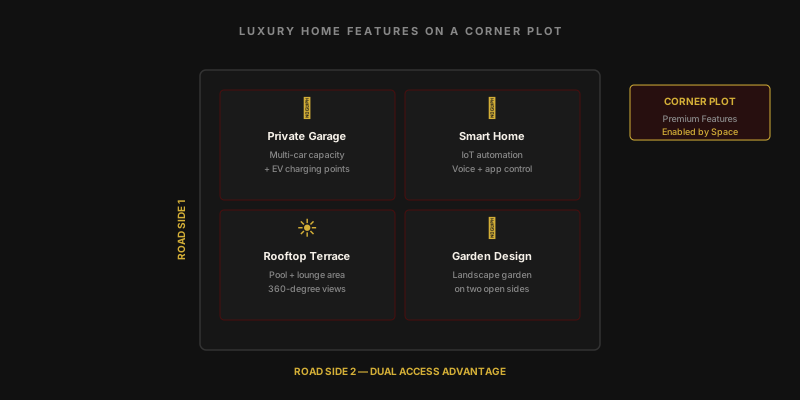
A rooftop terrace on an interior plot looks out at neighbouring houses on three sides. A rooftop on a corner plot has two sides facing open roads, providing longer sight lines, better breezes, and more sky. In Bangalore's Devanahalli or Hyderabad's Tellapur, where premium plotted developments back onto green belts or lake views, a corner plot rooftop captures the landscape that an interior plot's rooftop cannot.
The two open sides also simplify construction logistics. Crane access for lifting prefabricated pool shells, furniture, and pergola frames is dramatically easier when you can position the crane on either road. Interior plots often require hand-carrying heavy items through the narrow side passages, adding cost and time.
For privacy, install a 1.2-metre glass railing on the road-facing parapets and a dense planter box behind it with ornamental grasses like Pennisetum or Miscanthus. These grow to 1.5 metres in one season, creating a green privacy screen above the glass railing that blocks pedestrian sight lines while preserving your view outward.
Terrace Design Without a Pool
If the structural and maintenance commitment of a rooftop pool does not appeal to you, a well-designed rooftop terrace on a corner plot still delivers significant lifestyle value. Budget ₹3 to ₹6 lakh for:
- Waterproofing: SBS membrane with reflective cool-coat (Dr. Fixit or Sika) to reduce heat gain. Cost: ₹80 to ₹120 per sq ft.
- Flooring: Composite wood decking (brands: Greenply Greenlam, Everest Industries) at ₹200 to ₹400 per sq ft, or natural Kota stone at ₹80 to ₹150 per sq ft.
- Pergola: A steel or aluminium pergola with retractable fabric canopy for shade. Cost: ₹1.5 to ₹3 lakh for a 200 sq ft coverage area.
- Lighting: LED strip lighting under the pergola beams and recessed floor lights along the parapet. Budget: ₹50,000 to ₹1 lakh.
This creates a functional entertainment space for weekend dinners, an outdoor area to park after returning from a drive in your Mercedes or Audi, and an elevated vantage point that makes the most of a corner plot's dual road views.
On a Saturday evening in Hennur, Rohit lowers himself into the 28-degree plunge pool on his terrace as the sun drops behind the tree canopy, the Pentair filter hums beneath the deck, and the lights of Bangalore's northern corridor stretch along the Bellary Road horizon from his corner plot vantage.